I have a suspicion that Ron Stern is a great guy to hang out with. A full-time mathematics professor at Concordia University in Montreal, Prof. Stern decided to write a novel a few years back. According to the 2009 press release from Concordia, "Stern's goal was to write something satirical and over-the-top, but that still spoke truth about academia. The 'feel' of the story might be described as The Big Lebowsky meets Sideways in a campus novel."
My take? This is the work of an interesting academic who likes to push his personal boundaries, which explains why a mathematician is dabbling with fiction. As for the final product? Well, the novel leaves much to be desired, even if it is funny in parts.
Goldman's Theorem tells the story of Simon Goldman, a mathematics professor in the fictional University of Northern Vermont near the Canada - United States border. After years of apparent inactivity, Goldman announces that he has cracked the P versus NP Problem, which is one of the millennium problems. The news sparks a flurry of activity from the university's administrators who are eager to capitalize on this breakthrough. Yet amidst this joy from the university community, doubts begin to emerge on whether the proof is accurate.
This book left me with mixed feelings. When I first started reading it I thought it was terrible. It's true that Stern wanted to write a comedic book that poked fun at academic administrators, and that the slapstick humour was presented on purpose. This desire for high comedy, however, seemed to me like a veiled attempt to hide literary naivety. Stern is an accomplished mathematician, but an experienced fiction writer he is not, which comes across clearly in this book.
Nevertheless, things picked up about half-way through the story. Certain passages were quite funny and the writing significantly improved. My thoughts are that Stern got better as an author as he practiced writing fiction, which is why the second-half is much better than the first. As a result, by the end of the book, I become quite interested in the characters and the final outcome. That being said, if I had to do it again, I probably would not have picked up this book.
2 1/2 out of 5 stars
Showing posts with label Mathematics. Show all posts
Thursday, August 23, 2012
Friday, August 10, 2012
The Indian Clerk by David Leavitt
I am not sure how to react to this novel. Although it is beautifully written, impeccably researched and filled with several fascinating details, (the world painted here is so rich it could be an epic movie), this book still made me feel, "blah".
This novel is based on the incredible true story of Srinivasa Ramanujan, a self-taught mathematical genius who worked as a clerk in India, before being invited to Cambridge University after writing a letter to the famous English mathematician G.H. Hardy. In the ensuing pages, a vivid portrayal of England just prior and during World War I is presented, while a cast of famous characters (such as the renowned philosophers Bertrand Russell and Ludwig Wittgenstein, as well as the British mathematician John Littlewood) are scattered throughout the book.
So why am I so blasé about this story? The main problem is that Ramanujan, who is supposed to be the central focus of this book, comes across as an afterthought, playing second fiddle to Hardy's life. In fact, on various occasions, I had the sense that I was reading a literary biography of Hardy, rather than a novel about Ramanujan. As a result, after reading 478 pages, I still had no clear sense of who this brilliant Indian mathematician was, and instead was left with the sensation of having been given a long, generic sketch that could have been gathered by reading a Wikipedia entry.
The second problem with the novel is that it comes across as wooden in many parts. To use an image, the book reminded me of those stodgy, British-dramas that one only sees on TVO or PBS, and which despite looking interesting you never watch, because you know deep down inside that they will bore you. Coming to this realization after completing this book really upset me for I was really looking forward to reading it.
This novel is based on the incredible true story of Srinivasa Ramanujan, a self-taught mathematical genius who worked as a clerk in India, before being invited to Cambridge University after writing a letter to the famous English mathematician G.H. Hardy. In the ensuing pages, a vivid portrayal of England just prior and during World War I is presented, while a cast of famous characters (such as the renowned philosophers Bertrand Russell and Ludwig Wittgenstein, as well as the British mathematician John Littlewood) are scattered throughout the book.
So why am I so blasé about this story? The main problem is that Ramanujan, who is supposed to be the central focus of this book, comes across as an afterthought, playing second fiddle to Hardy's life. In fact, on various occasions, I had the sense that I was reading a literary biography of Hardy, rather than a novel about Ramanujan. As a result, after reading 478 pages, I still had no clear sense of who this brilliant Indian mathematician was, and instead was left with the sensation of having been given a long, generic sketch that could have been gathered by reading a Wikipedia entry.
The second problem with the novel is that it comes across as wooden in many parts. To use an image, the book reminded me of those stodgy, British-dramas that one only sees on TVO or PBS, and which despite looking interesting you never watch, because you know deep down inside that they will bore you. Coming to this realization after completing this book really upset me for I was really looking forward to reading it.
3 out of 5 stars
Tuesday, July 24, 2012
The Housekeeper and the Professor by Yoko Ogawa (Translated from the Japanese by Stephen Snyder)
A housekeeper is hired to take care of an old mathematics professor with a head injury. Due to a car accident in 1975, the professor’s memories stop in that year and any new memories are limited to 80-minutes. Once this period of time has passed, the new memories are replaced with other experiences that are 80-minutes long, in a process that is repeated endlessly. This lack of short-term memory, however, is compensated by the professor’s ability to maintain his mathematical knowledge, which he puts to constant use in the various math puzzle contests that he enters.
The professor’s sister-in-law explains this strange situation to the housekeeper before she begins her job. The sister then retreats to her house where she is no longer seen, leaving the housekeeper to take care of the professor – who lives in a neighbouring cottage – all by herself.
So each morning, as she arrives for work, the housekeeper must reintroduce herself to the professor, whose suit is filled with notes that remind him of important things, many of them mathematical, but others about new realities such as the presence of the housekeeper. From this unusual dynamic a beautiful friendship is born. The relationship becomes even stronger when the housekeeper’s son (who the professor calls “Root” because his flat head reminds him of the square root sign, a fact that he writes down in a note that is clipped onto his suit with a binder clip), begins to come to the cottage. The ensuing interactions between the three awaken a love of math in the housekeeper and her son, as they both come to see the beauty in numbers, and also the kind heart and soft nature of the professor.
In this lovely and touching novel, Yoko Ogawa paints a beautiful portrait filled with tenderness, true friendship and the wonder of mathematics. This book also declares that even in a world where memory is short (in this case, only 80-minutes long) humanity can still flourish, and friendship nurtured by the magic and wonder of numbers.
5 out of 5 stars
The professor’s sister-in-law explains this strange situation to the housekeeper before she begins her job. The sister then retreats to her house where she is no longer seen, leaving the housekeeper to take care of the professor – who lives in a neighbouring cottage – all by herself.
So each morning, as she arrives for work, the housekeeper must reintroduce herself to the professor, whose suit is filled with notes that remind him of important things, many of them mathematical, but others about new realities such as the presence of the housekeeper. From this unusual dynamic a beautiful friendship is born. The relationship becomes even stronger when the housekeeper’s son (who the professor calls “Root” because his flat head reminds him of the square root sign, a fact that he writes down in a note that is clipped onto his suit with a binder clip), begins to come to the cottage. The ensuing interactions between the three awaken a love of math in the housekeeper and her son, as they both come to see the beauty in numbers, and also the kind heart and soft nature of the professor.
In this lovely and touching novel, Yoko Ogawa paints a beautiful portrait filled with tenderness, true friendship and the wonder of mathematics. This book also declares that even in a world where memory is short (in this case, only 80-minutes long) humanity can still flourish, and friendship nurtured by the magic and wonder of numbers.
5 out of 5 stars
Sunday, July 22, 2012
Pythagoras’ Revenge: A Mathematical Mystery by Arturo Sangalli
This could have been a good novel. Unfortunately, weak writing and an inconsistent narrative flow undermine what is an otherwise interesting premise.
The story begins with a curious job interview between Jule Davidson, a mathematics professor at Indiana State University in Terre Haute, and a mysterious man who calls himself Mr. Smith. After passing a peculiar math test, Davidson is offered a strange job that is connected to the famous ancient Greek mathematician Pythagoras. In due course, the reader discovers that a manuscript from Pythagoras (who in real life left no written records) might exist.
The original plot revolves around various elements. There is a modern-day, neo-Pythagorean sect that is searching for the reincarnation of Pythagoras. Parallel to this religious search, Elmer Galway, a professor of classical history at Oxford University, discovers an Arabic scroll that hints at a written manuscript by the ancient Greek master. Then there is the world renowned mathematical genius Norton Thorp who proves than the vast majority of math problems are unsolvable. How all of these pieces fit together is the point of the book.
That is why it is disappointing that the storytelling is so jarring and jumpy. Characters are introduced and then discarded quickly, only to re-emerge later in a clunky way. Narrative pieces that should weave together nicely instead come across as awkward. Then there is the ending that seems rushed (one gets the impression that the author just wanted to finish the novel), which is too bad, as the idea behind the finale is quite interesting.
This book would have been a lot better if it had undergone a more thorough editing process. Some of the ideas are intriguing, such as the “proof” by Thorp that a majority of mathematical problems are unsolvable, and then the implication elsewhere in the book that this is a false proof that has been presented for malevolent reasons. Instead of fleshing out this and other excellent ideas, however, the novel is undermined by a poor narrative, ho-hum writing and fairly wooden characters.
2 1/2 out of 5 stars
The story begins with a curious job interview between Jule Davidson, a mathematics professor at Indiana State University in Terre Haute, and a mysterious man who calls himself Mr. Smith. After passing a peculiar math test, Davidson is offered a strange job that is connected to the famous ancient Greek mathematician Pythagoras. In due course, the reader discovers that a manuscript from Pythagoras (who in real life left no written records) might exist.
The original plot revolves around various elements. There is a modern-day, neo-Pythagorean sect that is searching for the reincarnation of Pythagoras. Parallel to this religious search, Elmer Galway, a professor of classical history at Oxford University, discovers an Arabic scroll that hints at a written manuscript by the ancient Greek master. Then there is the world renowned mathematical genius Norton Thorp who proves than the vast majority of math problems are unsolvable. How all of these pieces fit together is the point of the book.
That is why it is disappointing that the storytelling is so jarring and jumpy. Characters are introduced and then discarded quickly, only to re-emerge later in a clunky way. Narrative pieces that should weave together nicely instead come across as awkward. Then there is the ending that seems rushed (one gets the impression that the author just wanted to finish the novel), which is too bad, as the idea behind the finale is quite interesting.
This book would have been a lot better if it had undergone a more thorough editing process. Some of the ideas are intriguing, such as the “proof” by Thorp that a majority of mathematical problems are unsolvable, and then the implication elsewhere in the book that this is a false proof that has been presented for malevolent reasons. Instead of fleshing out this and other excellent ideas, however, the novel is undermined by a poor narrative, ho-hum writing and fairly wooden characters.
2 1/2 out of 5 stars
Friday, July 20, 2012
A Certain Ambiguity: A Mathematical Novel by Gaurav Suri and Hartosh Singh Bal
Awesome, absolutely awesome. This brilliant novel was a delight to read and I cannot recommend it enough. In the last month-and-a-half, I have been fortunate to come across several excellent books that have captivated my imagination. This fantastic story, however, is by far the best work of fiction that I have read in a long, long time.
This masterful tale revolves around Ravi Kapoor, a Stanford University student who by chance enrols in a course on infinity. Despite leaning towards a career in investment banking, Ravi befriends Nico, a jazz-loving math professor who encourages him to study mathematics and eschew the world of finance.
During the ensuing semester, Ravi discovers that his late grandfather Vijay Sahni, who was a mathematician, had been arrested in a small New Jersey town in 1919 for blasphemy. Surprised by this discovery, he begins to investigate the case which, to the surprise of him and his friends, shares common themes with Nico’s lecture on the infinite.
This book accomplishes so many things it is difficult to know where to start. First, the book explains complex math in a language that is accessible to everyone. Whether it’s the discussion on infinite levels of infinity, or the section dealing with non-Euclidean geometry, this book manages to describe high-level mathematics in an everyday tongue.
Second, this book touches on a myriad of powerful themes, such as the need by some people to find absolute truth in life; the role of faith in both science and religion; the power of friendship; the boundaries of human knowledge; and even hints of love. Page after page is filled with so many captivating ideas and thought provoking vignettes that it is sometimes difficult to keep up.
Finally, the philosophical and mathematical discussions are wrapped up in a wonderful story that is pure literature. The writing is exquisite, the pace of the story spot on and the characters are so alive they appear to be right in front of you. At times, the story was so engrossing I felt that I was beside Ravi and Nico as they discussed infinity, the meaning of life, the role of faith and the case of Ravi’s grandfather.
If I could give this book more than 5 stars I would. Easily the best book I have come across in years.
5 out of 5 stars
This masterful tale revolves around Ravi Kapoor, a Stanford University student who by chance enrols in a course on infinity. Despite leaning towards a career in investment banking, Ravi befriends Nico, a jazz-loving math professor who encourages him to study mathematics and eschew the world of finance.
During the ensuing semester, Ravi discovers that his late grandfather Vijay Sahni, who was a mathematician, had been arrested in a small New Jersey town in 1919 for blasphemy. Surprised by this discovery, he begins to investigate the case which, to the surprise of him and his friends, shares common themes with Nico’s lecture on the infinite.
This book accomplishes so many things it is difficult to know where to start. First, the book explains complex math in a language that is accessible to everyone. Whether it’s the discussion on infinite levels of infinity, or the section dealing with non-Euclidean geometry, this book manages to describe high-level mathematics in an everyday tongue.
Second, this book touches on a myriad of powerful themes, such as the need by some people to find absolute truth in life; the role of faith in both science and religion; the power of friendship; the boundaries of human knowledge; and even hints of love. Page after page is filled with so many captivating ideas and thought provoking vignettes that it is sometimes difficult to keep up.
Finally, the philosophical and mathematical discussions are wrapped up in a wonderful story that is pure literature. The writing is exquisite, the pace of the story spot on and the characters are so alive they appear to be right in front of you. At times, the story was so engrossing I felt that I was beside Ravi and Nico as they discussed infinity, the meaning of life, the role of faith and the case of Ravi’s grandfather.
If I could give this book more than 5 stars I would. Easily the best book I have come across in years.
5 out of 5 stars
Thursday, July 12, 2012
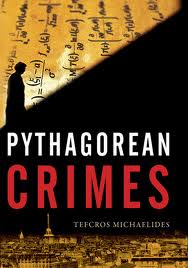
Pythagorean Crimes by Tefcros Michaelides (Translated from the Greek by Lena Cavanagh)
Michael Igerinos is shocked to hear that his best friend of 30 years, Stefanos Kantartzis, has been murdered. While interviewed by the police, Michael begins to recall his long-friendship with Stefanos, which begin in 1900, when both met as young men at the Second International Congress of Mathematics in Paris.
In the ensuing decades, both men share a myriad of adventures that see them drink in Montmartre with the then undiscovered Pablo Picasso, cross-paths with the famous Henri de Toulouse-Lautrec at the Moulin Rouge, share romances, fight in war, clash with a criminal gang involved in prostitution, and all the while discussing the latest advancements in mathematics.
Lurking in the shadows of this novel is the mysterious story of Hippasus of Mesapontum, the ancient Greek philosopher who legend has it was killed by the Pythagorean sect after he discovered that the square root of two, and hence the Pythagorean Theorem, was irrational. Does Hippasus’ death contain any clues on the murder of Stefanos? Or was his death simply the result of an act of revenge by an embittered criminal? This fascinating story filled with mathematicians, painters, poets, pimps, prostitutes, soldiers and rich upper class snobs provides a captivating answer. Michaelides's has produced a wonderful work that manages to combine complex mathematics with brilliant literature. A true triumph.
5 out of 5 stars
In the ensuing decades, both men share a myriad of adventures that see them drink in Montmartre with the then undiscovered Pablo Picasso, cross-paths with the famous Henri de Toulouse-Lautrec at the Moulin Rouge, share romances, fight in war, clash with a criminal gang involved in prostitution, and all the while discussing the latest advancements in mathematics.
Lurking in the shadows of this novel is the mysterious story of Hippasus of Mesapontum, the ancient Greek philosopher who legend has it was killed by the Pythagorean sect after he discovered that the square root of two, and hence the Pythagorean Theorem, was irrational. Does Hippasus’ death contain any clues on the murder of Stefanos? Or was his death simply the result of an act of revenge by an embittered criminal? This fascinating story filled with mathematicians, painters, poets, pimps, prostitutes, soldiers and rich upper class snobs provides a captivating answer. Michaelides's has produced a wonderful work that manages to combine complex mathematics with brilliant literature. A true triumph.
5 out of 5 stars
Sunday, July 8, 2012
The Parrot’s Theorem by Denis Guedj (Translated from the French by Frank Wynne)
Max Liard was in a Paris flea market when he noticed two men trying to catch a parrot. Disturbed by the fight between men and bird, the young Max, who is deaf, decides on the spot to save the colourful wing creature. This interesting scene is the opening act in a highly original novel that manages to recite the history of mathematics, while simultaneously doubling as a mystery book.
The story revolves around the Parisian bookstore of Mr. Ruche, an elderly wheelchair-bound man who lives with a woman named Perrette and her three children, one of which is Max. One day Mr. Ruche receives a letter from Elgar Grosrouvre, an old friend who he hasn’t seen in decades and who lives in Brazil. In his note, Elgar tells his former wartime comrade (both fought together during World War Two) that he was sending him a vast library of mathematical books, comprised of volumes that were published over a span of hundreds of years.
Surprised by the arrival of this gem of a collection, Mr. Ruches soon finds out that his old friend Elgar was working on ground-breaking mathematical proofs, but for reasons that are unclear died in a fire in his home in Manaus. Was it murder? Suicide? An accident? And what does the parrot have to do with all of the strange events in Brazil and the two men in the Paris flea market? While this mystery forms the backbone of the story, the real meat of the book lies with Mr. Ruche’s “presentations” on the history of mathematics to Perrette and her children that are based on Elgar’s library.
The story revolves around the Parisian bookstore of Mr. Ruche, an elderly wheelchair-bound man who lives with a woman named Perrette and her three children, one of which is Max. One day Mr. Ruche receives a letter from Elgar Grosrouvre, an old friend who he hasn’t seen in decades and who lives in Brazil. In his note, Elgar tells his former wartime comrade (both fought together during World War Two) that he was sending him a vast library of mathematical books, comprised of volumes that were published over a span of hundreds of years.
Surprised by the arrival of this gem of a collection, Mr. Ruches soon finds out that his old friend Elgar was working on ground-breaking mathematical proofs, but for reasons that are unclear died in a fire in his home in Manaus. Was it murder? Suicide? An accident? And what does the parrot have to do with all of the strange events in Brazil and the two men in the Paris flea market? While this mystery forms the backbone of the story, the real meat of the book lies with Mr. Ruche’s “presentations” on the history of mathematics to Perrette and her children that are based on Elgar’s library.
This book, which was originally written in French, is reminiscent of Sophie’s World by Jostein Gaarder, which outlined the history of philosophy through a highly imaginative novel. The Parrot’s Theorem echoes Gaarder’s classic work by showing how math evolved from the ancient Greeks to the 20th century. For the reader, this brilliant story turns the history of mathematics into a piece of literature that is full of romance, obsessions, tragedy and genius. If I had one critique, however, it is the somewhat weak ending. While the original plot and history of mathematics makes this a must read, the weak finale takes away from what is otherwise a brilliant book.
4 out of 5 stars
Thursday, July 5, 2012
The Sand-Reckoner by Gillian Bradshaw
The great Archimedes, arguably the most brilliant mathematician of Ancient Greece, is thriving in the intellectual hotbed of Alexandria when he hears the tragic news: His beloved father has fallen gravely ill and he must return to his native Syracuse. To make matters worse, his hometown is now at war with the Roman Empire, casting a menacing cloud over his family, friends and neighbours.
This intelligent and intriguing novel is set in 264 BC during the First Punic War. Archimedes and his slave Marcus (note: large parts of this story are fictionalized) arrive in Syracuse after spending three years in Ptolemy’s Museum in Alexandria. Eager to help in the defense of his home city, the young Greek quickly impresses with his engineering genius. His catapults are so powerful they are considered to be the strongest in the world, a view that is quickly confirmed when they crush invading Roman troops. His knowledge of mechanics, meanwhile, allows him to stun his fellow citizens of Syracuse by moving a ship with a lever. In the midst of battle, family sorrow and displays of technical brilliance, Archimedes learns about love, true friendship, loyalty and the horror of war.
Gillian Bradshaw is a wonderful writer who has a delightful eye for detail. In this excellent novel, she brings Ancient Greece to life and is able to take the reader into the heart of Archimedes’ home. Although the ending was a tad too soap operaish for my taste, I was still drawn in by this book and really enjoyed reading it.
4 out of 5 stars
This intelligent and intriguing novel is set in 264 BC during the First Punic War. Archimedes and his slave Marcus (note: large parts of this story are fictionalized) arrive in Syracuse after spending three years in Ptolemy’s Museum in Alexandria. Eager to help in the defense of his home city, the young Greek quickly impresses with his engineering genius. His catapults are so powerful they are considered to be the strongest in the world, a view that is quickly confirmed when they crush invading Roman troops. His knowledge of mechanics, meanwhile, allows him to stun his fellow citizens of Syracuse by moving a ship with a lever. In the midst of battle, family sorrow and displays of technical brilliance, Archimedes learns about love, true friendship, loyalty and the horror of war.
Gillian Bradshaw is a wonderful writer who has a delightful eye for detail. In this excellent novel, she brings Ancient Greece to life and is able to take the reader into the heart of Archimedes’ home. Although the ending was a tad too soap operaish for my taste, I was still drawn in by this book and really enjoyed reading it.
4 out of 5 stars
Thursday, June 21, 2012
The Wild Numbers by Philibert Schogt
Feeling that he has failed as a mathematician, Isaac Swift retreats to his apartment to wallow in his sorrow. Alone in his study, he begins to work on Beauregard’s Wild Number Problem, a puzzle that has stumped mathematicians for centuries. As he slowly searches for a solution, his intellectual quest drives him to the brink of madness until (to his complete shock) he writes a proof.
After overcoming his initial disbelief of what he has done, Isaac approaches his university colleague, and world renowned math genius, Dimitri to review his work. With painstaking detail, Dimitri reviews the proof step-by-step, until concluding that his fellow professor has found the secret to one of the world’s most important problems. Lost amid the joy of this discovery, however, are the deranged fantasies of a mature student named Mr. Vale, who accuses Isaac of plagiarizing his solution to the Wild Number Problem. Quick to maintain his innocence, Isaac must deal with Mr. Vale’s erratic threats, while also maintaining in check his own descent into lunacy.
This book is a captivating read that highlights the fine line between genius and madness, success and failure. Though heavily focused on mathematics, the story is accessible to all readers, and can capture the imagination of a wide audience. As well, while the writing does sound wooden at times, the story has an excellent pace that captivates to the end. It also handles a difficult subject matter in an entertaining an accessible way, and also leaves the reader thinking about whether poor Isaac has truly gone mad.
3 1/2 out of 5 stars
After overcoming his initial disbelief of what he has done, Isaac approaches his university colleague, and world renowned math genius, Dimitri to review his work. With painstaking detail, Dimitri reviews the proof step-by-step, until concluding that his fellow professor has found the secret to one of the world’s most important problems. Lost amid the joy of this discovery, however, are the deranged fantasies of a mature student named Mr. Vale, who accuses Isaac of plagiarizing his solution to the Wild Number Problem. Quick to maintain his innocence, Isaac must deal with Mr. Vale’s erratic threats, while also maintaining in check his own descent into lunacy.
This book is a captivating read that highlights the fine line between genius and madness, success and failure. Though heavily focused on mathematics, the story is accessible to all readers, and can capture the imagination of a wide audience. As well, while the writing does sound wooden at times, the story has an excellent pace that captivates to the end. It also handles a difficult subject matter in an entertaining an accessible way, and also leaves the reader thinking about whether poor Isaac has truly gone mad.
3 1/2 out of 5 stars
Sunday, June 17, 2012
An Invisible Sign Of My Own by Aimee Bender
Mona Gray is a 20-year-old, Grade 2 math teacher with
curious habits: a compulsive need to knock on things, whether trees, walls or
desks; a desire to quit everything that she is good at (except for math); and a
knack of noticing strange things, like the unusual practice of Mr. Jones (her former
school math teacher and now owner of the town hardware store), who wears wax
necklaces of individual numbers that switch daily to indicate his changing moods.
5 out of 5 stars
In the background to this offbeat life, is the shadow of
Mona’s father who has been sick for years with an unspecified illness. He
hovers over Mona’s thoughts and feelings, and is omnipresent when she interacts
with her seven-year-old students and other teachers, especially Mr. Smith, the
new science teacher who is bound to be fired in no time.
This book is spectacular. Despite being only her
second novel, the writing comes across as the work of a master. The literary
flow in this book is so good that you sometimes forget that you are reading a
story and start to imagine that you are peeking into the mind of a peculiar
woman, who comes across as both brilliant and simple, insightful and hopefully naïve.
Without a doubt this is a gem and a delight to read. An excellent work that is
in a class of its own.
5 out of 5 stars
Coyote Moon by John A. Miller
After watching his brilliant and close friend Arthur
Hodges die, (a world renowned thinker who held an endowed chair of mathematics
at MIT), quantum physicist Benny Rhodes has an epiphany: He must quit his job
as a university professor and divorce his wife. In what seems like a flash
instant, he leaves Boston and travels across the country where he meets a woman who is more than 30 years younger in the parking lot of a drugstore in Oklahoma after their cars collide. The new
couple soon find themselves in a trailer park in the Mojave desert, where they
meet a strange German couple who believe (or at least the husband does) that
they have all come together for a special, perhaps even mystical, reason.
Meanwhile, in Scottsdale, Arizona, a mysterious young man
just out of the army, and who has never played formal organized baseball in his
life, shows up at the training camp of the Oakland A’s. First dismissed as a
nonentity, the player is told flat out that he has no chance of making the
team. But when his playing ability reveals him to be a bona fide superstar (some are so shocked by his skill that they wonder
if he made a pack with the devil) he is quickly offered a professional
contract. Even weirder than his raw talent, however, is his bizarre
mathematical ability, and his knowledge of advanced physics. When the player finds
himself in the trailer park in the Mojave desert, a debate ensues about whether
he is the reincarnation of a scientific genius.
This wonderfully original book was a pure joy to read.
With amazing literary skill and a wonderful imagination, John Miller has written
a book that is worthy of extensive praise. If this novel were a symphony, it
would receive a standing ovation for several minutes from an adoring audience.
5 out of 5 stars
The Fractal Murders by Mark Cohen
Three math professors in three different U.S. states are found dead. At first glance, none of the cases appear related, except for the odd fact that all three were experts of fractal geometry. Convinced that this link is not a mere coincidence, math professor Jayne Smyers from Boulder, Colorado, hires private detective (and former Marine JAG) Pepper Keane to investigate.
In the ensuing search, Pepper finds himself travelling to several states, taking a road trip with his best friend, and unravelling a mathematical secret that was designed to beat the stock market. As he gets closer to the truth about the three dead professors, he finds himself falling in love with the affable Prof. Smyers, all the while working through the fascinating (but poorly written!) philosophical classic Being and Time from the German philosopher Martin Heidegger.
This fast-paced novel is a fun read that will appeal to mystery fans and lovers of math / philosophy alike. A good, fun book that is worth picking up.
3 out of 5 stars
In the ensuing search, Pepper finds himself travelling to several states, taking a road trip with his best friend, and unravelling a mathematical secret that was designed to beat the stock market. As he gets closer to the truth about the three dead professors, he finds himself falling in love with the affable Prof. Smyers, all the while working through the fascinating (but poorly written!) philosophical classic Being and Time from the German philosopher Martin Heidegger.
This fast-paced novel is a fun read that will appeal to mystery fans and lovers of math / philosophy alike. A good, fun book that is worth picking up.
3 out of 5 stars
Monday, January 31, 2011
White Light by Rudy Rucker
Felix Rayman is a frustrated mathematics teacher at a state college in New York. "Some fool or misanthrope had acronymed the college SUCAS," sighs Felix, as he has to face the reality of an unfulfilling academic career.
His home life, meanwhile, is no bed of roses either. "When I got home April would always be lying on the couch staring at the TV with the sound off," notes Felix, as he thinks about his wife. "She would just lie there in silence until I came over and asked how she was. The answer was always the same. She was pissed-off, fed-up, and dead sick of it all. The hick town, the constant baby care (of their baby girl Iris), the shopping in sleazy chain stores, the problems with the car, what the neighbor lady had said today, and so on and on.'
Amid this unhappy mix, Felix keeps himself busy by trying to find a solution to Georg Cantor's continuum problem, while experimenting with lucid dreaming and fuzzy weed, i.e. marijuana. After visiting a local bookshop, where he discovers a strange pamphlet about a world called Cimön, Felix experiences an out-of-body experience in which his astral body leaves his physical self. While travelling in the astral realm, he is almost captured by the Devil, only to be saved by Jesus. Felix is then asked by Jesus to take care of a ghost called Kathy, and to bring her to Cimön, where they can merge with God / Absolute Infinity.
While travelling in this astral world, Felix undergoes a surreal set of adventures that includes: transforming into Donald Duck before having his "Duck" heart cut out by an Aztec priest; befriending a giant beetle called Franx that is reminiscent of the bug in Franz Kafka's The Metamorphosis; checking into an infinite hotel modeled after the famous mathematical paradox by the renowned mathematician David Hilbert; and meeting such famous thinkers as Albert Einstein and Georg Cantor. Within this surreal landscape the reader is presented with a vision (albeit a very weird one) of the mathematical concepts of transfinite numbers and Cantor's absolute infinity.
This is the third book by Rudy Rucker that I have read and it is the only one that I have enjoyed. Unlike the previous two novels, which can be described as poor parodies of a Salvador Dali painting, the characters in this book are not absurd caricatures, but rather interesting persons. The writing is also infinitely (no pun intended) better that his other works that I have read.
That being said, it is clear that Rucker's instinct is to be the far-out, weird math guy, and as such, this novel does contain the occasional bizarre rant. In fact, by the end of the book, I was starting to worry that Rucker was going to descend into pointless gibberish, like in some of his other books. To my pleasant surprise, however, this book did not become a bad literary version of an acid trip, but rather provided some interesting food for thought about the concept of infinity.
This book is definitely not for everyone, but if you want to read a novel that mixes math with hallucinatory images, then you will find this work interesting.
3 out of 5 stars
His home life, meanwhile, is no bed of roses either. "When I got home April would always be lying on the couch staring at the TV with the sound off," notes Felix, as he thinks about his wife. "She would just lie there in silence until I came over and asked how she was. The answer was always the same. She was pissed-off, fed-up, and dead sick of it all. The hick town, the constant baby care (of their baby girl Iris), the shopping in sleazy chain stores, the problems with the car, what the neighbor lady had said today, and so on and on.'
Amid this unhappy mix, Felix keeps himself busy by trying to find a solution to Georg Cantor's continuum problem, while experimenting with lucid dreaming and fuzzy weed, i.e. marijuana. After visiting a local bookshop, where he discovers a strange pamphlet about a world called Cimön, Felix experiences an out-of-body experience in which his astral body leaves his physical self. While travelling in the astral realm, he is almost captured by the Devil, only to be saved by Jesus. Felix is then asked by Jesus to take care of a ghost called Kathy, and to bring her to Cimön, where they can merge with God / Absolute Infinity.
While travelling in this astral world, Felix undergoes a surreal set of adventures that includes: transforming into Donald Duck before having his "Duck" heart cut out by an Aztec priest; befriending a giant beetle called Franx that is reminiscent of the bug in Franz Kafka's The Metamorphosis; checking into an infinite hotel modeled after the famous mathematical paradox by the renowned mathematician David Hilbert; and meeting such famous thinkers as Albert Einstein and Georg Cantor. Within this surreal landscape the reader is presented with a vision (albeit a very weird one) of the mathematical concepts of transfinite numbers and Cantor's absolute infinity.
This is the third book by Rudy Rucker that I have read and it is the only one that I have enjoyed. Unlike the previous two novels, which can be described as poor parodies of a Salvador Dali painting, the characters in this book are not absurd caricatures, but rather interesting persons. The writing is also infinitely (no pun intended) better that his other works that I have read.
That being said, it is clear that Rucker's instinct is to be the far-out, weird math guy, and as such, this novel does contain the occasional bizarre rant. In fact, by the end of the book, I was starting to worry that Rucker was going to descend into pointless gibberish, like in some of his other books. To my pleasant surprise, however, this book did not become a bad literary version of an acid trip, but rather provided some interesting food for thought about the concept of infinity.
This book is definitely not for everyone, but if you want to read a novel that mixes math with hallucinatory images, then you will find this work interesting.
3 out of 5 stars
Saturday, January 1, 2011
The Dot and the Line: A Romance in Lower Mathematics by Norton Juster
There was once a sensible straight line who fell in love with a dot. Unfortunately, the dot was a frivolous creature who preferred the chaos of a squiggly line. Heartbroken, the straight line decided to transform itself into countless shapes (e.g fractals, spider web, a maze, numerous geometric shapes, etc.) to win the affection of the dot.
What can one say about this tiny, cute, novel and strange book? I think it's best to quote from the book's jacket cover, "Some may call [this story] a poignant and sensitive evocation of an eternal theme. Other may see it as a sensitive, soul-searching examination of a heart-wrenching dilemma.
"Or, in these uncertain times, we we seem to stand alienated from the meaning of life itself, it is a shining beacon illumination the pat to some higher understanding?
What can one say about this tiny, cute, novel and strange book? I think it's best to quote from the book's jacket cover, "Some may call [this story] a poignant and sensitive evocation of an eternal theme. Other may see it as a sensitive, soul-searching examination of a heart-wrenching dilemma.
"Or, in these uncertain times, we we seem to stand alienated from the meaning of life itself, it is a shining beacon illumination the pat to some higher understanding?
"We doubt it."
3 out of 5 stars
3 out of 5 stars
Spaceland: A Novel of the Fourth Dimension by Rudy Rucker
Joe Cube is a high-tech worker living in Silicon Valley who wants to develop a 3-D TV. On New Year's Eve, while working on his prototype, he is visited by a creature from the fourth-dimension named Momo who tells him that he can give him an advanced new technology.
In the ensuing pages, the reader is taken on a screwball sci-fi adventure involving Joe Cube (the names in this novel are awful), his wife Jena, and other characters with such names as Spazz, Tulip and the strange Wackles. As Joe works towards attaining this strange new technology, he is caught up in a geopolitical struggle between two different fourth-dimensional worlds, while having his body "augmented" so he can leave Spaceland (i.e. the three-dimensional world where humans live) in order to be able see into the hyperspace of 4-D.
This book is a modern rendition of the sci-fi classic Flatland, the 19th century story of a two dimensional creature that is introduced to the third dimension. Unlike the original story, however, Spaceland is hampered by some terrible writing. The dialogue is particularly horrific, while the cheesy humor throughout Spaceland comes across as a weak attempt to hide wooden characters that are (if I can use the expression) one-dimensional.
This is the second book by Rudy Rucker that I have read and, once again, I have not been impressed. It's true that Rucker's ideas are interesting, and that his background as a mathematician, computer scientist and professor give him a lot of legitimacy. As a novelist, however, I find him quite weak, and I am still not sure why he is held in such high esteem by some science fiction fans.
In the ensuing pages, the reader is taken on a screwball sci-fi adventure involving Joe Cube (the names in this novel are awful), his wife Jena, and other characters with such names as Spazz, Tulip and the strange Wackles. As Joe works towards attaining this strange new technology, he is caught up in a geopolitical struggle between two different fourth-dimensional worlds, while having his body "augmented" so he can leave Spaceland (i.e. the three-dimensional world where humans live) in order to be able see into the hyperspace of 4-D.
This book is a modern rendition of the sci-fi classic Flatland, the 19th century story of a two dimensional creature that is introduced to the third dimension. Unlike the original story, however, Spaceland is hampered by some terrible writing. The dialogue is particularly horrific, while the cheesy humor throughout Spaceland comes across as a weak attempt to hide wooden characters that are (if I can use the expression) one-dimensional.
This is the second book by Rudy Rucker that I have read and, once again, I have not been impressed. It's true that Rucker's ideas are interesting, and that his background as a mathematician, computer scientist and professor give him a lot of legitimacy. As a novelist, however, I find him quite weak, and I am still not sure why he is held in such high esteem by some science fiction fans.
If you are interested in stories about multi-dimensional space, you should forego this book and read instead such works as Flatland, Sphereland and the Planiverse.
1 out of 5 stars
The Number Devil: A Mathematical Adventure by Hans Magnus Enzensberger
This delightful children's book is an ingenious way of teaching young people about the wonders of mathematics. In this imaginative tale, a young boy named Robert falls asleep and in his dream meets an impish, elderly man who calls himself the Number Devil. Over a series of nights (and dreams), the Number Devil teaches Robert such concepts as prime numbers, infinity, the Fibonacci numbers, pi, imaginary numbers and square roots. Along the way, Robert is introduced to such famous mathematicians as Bertrand Russell, Georg Cantor, Friedrich Gauss and Pythagoras.
Reading this book reminded me of Sophie's World, the wonderful novel by Jostein Gaarder that provides an excellent summary of the history of western philosophy. Like Gaarder (who is able to convey a wide array of ideas with a brilliant tale), Hans Magnus Enzensberger finds a way to explain a wide range of mathematical ideas to his young audience, while simultaneously entertaining them. This is a great book for any parent who wants to teach their young children math.
4 out of 5 stars
Reading this book reminded me of Sophie's World, the wonderful novel by Jostein Gaarder that provides an excellent summary of the history of western philosophy. Like Gaarder (who is able to convey a wide array of ideas with a brilliant tale), Hans Magnus Enzensberger finds a way to explain a wide range of mathematical ideas to his young audience, while simultaneously entertaining them. This is a great book for any parent who wants to teach their young children math.
4 out of 5 stars
Fermat's Enigma: The Epic Quest to Solve the World's Greatest Mathematical Problem by Simon Singh
This book is a wonderful recount of how Fermat's last theorem, one of the world's most (in)famous math problems that eluded mathematicians for more than 350 years, was finally solved by the British mathematician Andrew Wiles in the 1990s.
Written in easy to understand prose, Singh not only describes the amazing intellectual breakthroughs that were required to solve this problem, but in the process also recounts the tale of such mathematicians as Sophie Germain, the tragic boy-genius Evariste Galois and the Japanese duo of Taniyama and Yutaka that helped set the stage for Wiles historic and brilliant solution.
4 out of 5 stars
Written in easy to understand prose, Singh not only describes the amazing intellectual breakthroughs that were required to solve this problem, but in the process also recounts the tale of such mathematicians as Sophie Germain, the tragic boy-genius Evariste Galois and the Japanese duo of Taniyama and Yutaka that helped set the stage for Wiles historic and brilliant solution.
4 out of 5 stars
Thursday, December 30, 2010
Sphereland: A Fantasy About Curved Spaces and an Expanding Universe by Dionys Burger
This book is the sequel to Flatland, the peculiar fantasy novel by Edwin Abbott that was released in 1884, and which tells the story of the mathematician A. Square who lives in a two-dimensional world. After coming into contact with a being from a higher dimension, A. Square discovers the wonders of three-dimensional space, and postulates the existence of even higher dimensions. Instead of being declared a hero, however, he is jailed for preaching the heresy of higher-dimensional worlds.
In the sequel Sphereland, which was Published in 1965, or more than 80 years after Abbott's book's first appearance, the reader is introduced to A. Square's grandson, who discovers that Flatland is actually made up of curved space. This amazing discovery leads him to postulate that the third dimension, which is home to bizarre figures called homo sapiens, is curved by a fourth dimensional world..
From a purely geek perspective, this book is an interesting thought experiment. From a literary point of view, on the other hand, the written is unfortunately quite wooden. As a science fiction fan I often let poor writing slide if the idea is interesting. In this case, however, the weak narrative structure does not make up for the interesting mathematical ideas. That being said, I enjoyed this book, though I must also confess that I like books with characters called A. Square, so I understand why this novel would not be everyone's -- if not the vast majority of people's -- cup of tea.
2 1/2 out of 5 stars
In the sequel Sphereland, which was Published in 1965, or more than 80 years after Abbott's book's first appearance, the reader is introduced to A. Square's grandson, who discovers that Flatland is actually made up of curved space. This amazing discovery leads him to postulate that the third dimension, which is home to bizarre figures called homo sapiens, is curved by a fourth dimensional world..
From a purely geek perspective, this book is an interesting thought experiment. From a literary point of view, on the other hand, the written is unfortunately quite wooden. As a science fiction fan I often let poor writing slide if the idea is interesting. In this case, however, the weak narrative structure does not make up for the interesting mathematical ideas. That being said, I enjoyed this book, though I must also confess that I like books with characters called A. Square, so I understand why this novel would not be everyone's -- if not the vast majority of people's -- cup of tea.
2 1/2 out of 5 stars
One to Nine: The Inner Life of Numbers by Andrew Hodges
Imagine you are a mathematician who is drinking in a bar with your buddies. Several hours into your drinking session, a half-drunk friend says the following, "hey, I bet you can't write a book about the numbers 1 through 9." Intrigued by the challenge, you proceed to take up the drunken bet, and write a book about the first nine integers. The book contains some interesting parts -- such as the relationship between the prime numbers and 4/4 musical time -- but it also contains long passages that come across as aimless rambling. In other sections, meanwhile, it seems that you are not interested in providing insights to the reader, but are rather using the book as an excuse to show-off all of your scientific knowledge. In a nutshell, that is how this work came across to me. Without a doubt, it contains a lot of interesting ideas, and if it were structured differently it could have provided a great learning tool. Sadly, however, I was largely put off by the book, and by the last pages all I wanted was for it to end.
2 out of 5 stars
2 out of 5 stars
Tuesday, December 28, 2010
Flatland: A Journey of Many Dimensions, the Movie Edition by Edwin A. Abbott; (Introduction) Lori M. Campbell
This book is a delightful read. Written in 1884, this "memoir" tells the story of A. Square, a being in a two-dimensional world called Flatland. On the eve of the year 1999 in the Flatland calendar, A. Square -- who is a mathematician -- is visited by a creature from the third dimension, who introduces him to the fantastic world of three-dimensional space, and the possibility of worlds with four or even more dimensions. The original novel by Edwin Abbott contained a strong critique of Victorian Society, with its class divisions and subjugation of women. Besides these social commentaries, however, it also contained a fascinating discussion of multi-dimensional reality, which is amazing when once remembers that this book was written in the 19th century, or several decades before physicists started to seriously talk about extra dimensions. This short book is a wonderful work of fiction that captures the imagination, by leading the reader to wonder about their real place in the universe.
4 out of 5 stars
4 out of 5 stars
Subscribe to:
Posts (Atom)