Showing posts with label Mystery. Show all posts

Monday, June 3, 2013

The Poisoned Pawn by Peggy Blair

The Poisoned Pawn, which was released this past February, is the sequel to Peggy Blair's excellent debut novel The Beggar's Opera.

The sequel continues the highly complex plot from the first book, which encompasses Canada-Cuba relations, an international criminal ring with links to the Vatican, and difficult images from the streets of Ottawa that local residents often ignore.

While continuing with the wonderful characters from the first book, notably  Inspector Ramirez and the brilliant pathologist Hector Apiro, who suffers from dwarfism, the sequel introduces a new set of characters, such as Charlie Pike, an aboriginal police officer who started as a beat cop on the streets of Winnipeg and who escorts Ramirez during his trip to Canada. (The first book takes place in Havana, the second in Ottawa). 

As a resident of Ottawa, I thoroughly enjoyed reading a mystery set in my home city.  Truth be told, however, I would have loved this book regardless of where I lived, for this novel will appeal to mystery fans around the world.  So if you are not familiar with Blair's work, do yourself a favour and go out and read her two books.

4 out of 5 stars.

Sunday, June 2, 2013

The Beggar's Opera by Peggy Blair

Ricardo Ramirez, the police inspector in charge of the Havana Major Crimes Unit, sees dead people. Yet again, his ability to interact with the ghosts of murdered victims may be a mental disease, perhaps even the same one that killed his grandmother.

A Canadian police officer from Ottawa, meanwhile, is arrested for the rape and murder of a young boy while vacationing in Havana. From this captivating beginning, Peggy Blair opens her debut novel The Beggar’s Opera, which tells the story of arguably Cuba’s greatest fictional police inspector.

The idea for the books stem from a trip that Blair took to Havana in December 2006 with her daughter. Having just left a 30-year legal career, which included working in the heart wrenching residential school process, she was in a period of transition. After her daughter encouraged her to do something active she started to write.

Moved by her daughter’s words, as well as her trip to Old Havana in Christmas of 2006, Blair came up with the idea of writing a mystery set in Cuba. The result is a wonderful literary efforts with unforgettable characters. There is Inspector Ramirez, a first-class detective who sees the ghosts of murdered people. In addition to solving crimes, he has to deal with the shortages facing Cuba, such as the lack of fuel for police vehicles.

Then there is Hector Apiro, a brilliant pathologist and one of Cuba’s top plastic surgeons who suffers from dwarfism. His small physical stature hides his genius mind and deep compassion. All in all this is wonderful mystery novel that is well worth the read.

4 out of 5 stars

Sunday, August 12, 2012

Body of Intuition by Claire Daniels

I read this novel by accident. While logging onto my online library account, I noticed that there was an interlibrary loan book on hold for me. Not recognizing the title, I called the library to make sure there hadn't been a mistake. I was told that there was no error and that I had reserved the book.

I then went to the library to pick up the book and immediately saw that someone else's name was on the interlibrary loan reservation sheet. Instead of returning the book, however, I decided to read the plot summary on the back cover. The story revolves around a character called Calypso Lazar ("call me Cally") who is a former lawyer turned new-age healer. After one of her clients describes how her husband died in an apparent suicide at an intimacy workshop, Cally decides to investigate and soon discovers that the death was the result of murder.

This oddball plot was so corny I had to give it a shot. I don't know what I was expecting, but I soon discovered that this is a terrible novel. The writing is atrocious, the characters one-dimensional, the dialogue so cheesy I could barely believe it, and the narrative pace very choppy. In fact, at times I felt that this was the work of a high school student rushing through an English assignment instead of the work of a professional author. The only positive thing I can say about this book is that the story idea is highly imaginative and the main character is a quirky, if implausible, creation.

1 out of 5 stars

Sunday, July 22, 2012

Pythagoras’ Revenge: A Mathematical Mystery by Arturo Sangalli

This could have been a good novel. Unfortunately, weak writing and an inconsistent narrative flow undermine what is an otherwise interesting premise.

The story begins with a curious job interview between Jule Davidson, a mathematics professor at Indiana State University in Terre Haute, and a mysterious man who calls himself Mr. Smith. After passing a peculiar math test, Davidson is offered a strange job that is connected to the famous ancient Greek mathematician Pythagoras. In due course, the reader discovers that a manuscript from Pythagoras (who in real life left no written records) might exist.

The original plot revolves around various elements. There is a modern-day, neo-Pythagorean sect that is searching for the reincarnation of Pythagoras. Parallel to this religious search, Elmer Galway, a professor of classical history at Oxford University, discovers an Arabic scroll that hints at a written manuscript by the ancient Greek master. Then there is the world renowned mathematical genius Norton Thorp who proves than the vast majority of math problems are unsolvable. How all of these pieces fit together is the point of the book.

That is why it is disappointing that the storytelling is so jarring and jumpy. Characters are introduced and then discarded quickly, only to re-emerge later in a clunky way. Narrative pieces that should weave together nicely instead come across as awkward. Then there is the ending that seems rushed (one gets the impression that the author just wanted to finish the novel), which is too bad, as the idea behind the finale is quite interesting.

This book would have been a lot better if it had undergone a more thorough editing process. Some of the ideas are intriguing, such as the “proof” by Thorp that a majority of mathematical problems are unsolvable, and then the implication elsewhere in the book that this is a false proof that has been presented for malevolent reasons. Instead of fleshing out this and other excellent ideas, however, the novel is undermined by a poor narrative, ho-hum writing and fairly wooden characters.

2 1/2 out of 5 stars

Thursday, July 12, 2012

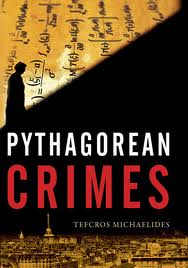
Pythagorean Crimes by Tefcros Michaelides (Translated from the Greek by Lena Cavanagh)

Michael Igerinos is shocked to hear that his best friend of 30 years, Stefanos Kantartzis, has been murdered. While interviewed by the police, Michael begins to recall his long-friendship with Stefanos, which begin in 1900, when both met as young men at the Second International Congress of Mathematics in Paris.

In the ensuing decades, both men share a myriad of adventures that see them drink in Montmartre with the then undiscovered Pablo Picasso, cross-paths with the famous Henri de Toulouse-Lautrec at the Moulin Rouge, share romances, fight in war, clash with a criminal gang involved in prostitution, and all the while discussing the latest advancements in mathematics.

Lurking in the shadows of this novel is the mysterious story of Hippasus of Mesapontum, the ancient Greek philosopher who legend has it was killed by the Pythagorean sect after he discovered that the square root of two, and hence the Pythagorean Theorem, was irrational. Does Hippasus’ death contain any clues on the murder of Stefanos? Or was his death simply the result of an act of revenge by an embittered criminal? This fascinating story filled with mathematicians, painters, poets, pimps, prostitutes, soldiers and rich upper class snobs provides a captivating answer. Michaelides's has produced a wonderful work that manages to combine complex mathematics with brilliant literature. A true triumph.

5 out of 5 stars

Sunday, June 17, 2012

The Fractal Murders by Mark Cohen

Three math professors in three different U.S. states are found dead. At first glance, none of the cases appear related, except for the odd fact that all three were experts of fractal geometry. Convinced that this link is not a mere coincidence, math professor Jayne Smyers from Boulder, Colorado, hires private detective (and former Marine JAG) Pepper Keane to investigate.

In the ensuing search, Pepper finds himself travelling to several states, taking a road trip with his best friend, and unravelling a mathematical secret that was designed to beat the stock market. As he gets closer to the truth about the three dead professors, he finds himself falling in love with the affable Prof. Smyers, all the while working through the fascinating (but poorly written!) philosophical classic Being and Time from the German philosopher Martin Heidegger.

This fast-paced novel is a fun read that will appeal to mystery fans and lovers of math / philosophy alike. A good, fun book that is worth picking up.

3 out of 5 stars

Monday, February 28, 2011

The Full Cupboard of Life by Alexander McCall Smith

One of the most delightful literary works that I have recently stumbled across is the No. 1 Ladies' Detective Agency series. Set in Botswana, the adventures of Precious Ramotswe not only present an uplifting vision of Africa, but also tell the stories of a wonderful set of characters that are positive, kindhearted and interesting.

That it why I was so disappointed with this dud of a book, which is the fifth installment in the series. To begin with, the main mystery to be solved (i.e. a rich woman hires Precious to check on the backgrounds of some possible suitors for marriage) is a bit ho-hum. The character development and story flow, meanwhile, lacks the sparkle that made the earlier books such a gem to read.

Now it is true that certain parts of the book are enjoyable, such as Mma Potokwane's unconventional idea of having a fundraiser for her Orphan Farm through a parachute jump. With great skill, Mma Potokwane is able to convince Mr. J.L.B. Matekoni into jumping from an airplane, only to have Rra Matekoni (through the clever assistance of Precious) convince his older apprentice to jump in his place. Then there is the question of when Mr. Matekoni will finally marry Precious after such a long engagement.

These flashes of fun, however, are undermined by a book that is, to be frank, a bit dull. Not much happens in this fifth installment of the series, making it by far the weakest novel of the first five. When I finished reading this book, I couldn't help but compare it to a poor episode of an otherwise excellent TV series. In other words, I definitely won't "watch" this book as a "re-run," but I will certainly continue with the rest of the series.

2 1/2 of out 5 stars

Saturday, February 26, 2011

The Kalahari Typing School for Men by Alexander McCall Smith

Precious Ramotswe didn't know how to react when she first learned that a new detective agency had opened across town. It wasn't that she was against having competition (she was fine with that), no, it was the smug, arrogant and -- to be perfectly blunt -- sexist attitude of the new agency's male owner.

While having to face the condescending competition, Precious has to tackle a series of cases. There is the man who wants to make amends for his past sins, and who hires Botswana's leading female detective to help him do so. Then there is the wife who is convinced that her husband is cheating on her, which leads to a discovery that shocks the kindhearted Precious.

Amidst this detective work, Mma Makutsi, the earnest and bright assistant of Precious, conceives of the idea of opening up a typing school for men, where businessmen can learn the "secretarial" skill of typing (which is very useful for those who work with computers) while in the safe company of other men. With this entrepreneurial spirit, Mma Makutsi is able to overcome some of her financial hardships.

This is the fourth installment in the No. 1 Ladies' Detective Agency series, and like the previous three books I enjoyed this story a lot. That being said, if I had one complaint with this novel it is that it starts off fairly slow. In fact, by around page 40, I was starting to get bored. Soon after, however, I was drawn into the story, and was reminded why I enjoy this series so much. With simple (though clever) writing, McCall Smith discusses serious themes -- e.g. sexism, orphans, an indirect reference to the AIDS epidemic -- while presenting warm, intelligent and honest characters.

3 1/2 out of 5 stars

Sunday, February 6, 2011

Morality for Beautiful Girls by Alexander McCall Smith

Precious Ramotswe knew something was wrong when her fiancé, Mr. J.L.B. Matekoni, stopped going to his garage, while mumbling about the horrible things that he had done in his life. Worried about this strange turn of events, Mma Ramotswe soon discovers that her beloved is suffering from depression, and that his condition is more complicated than she first thought.

While dealing with her love's unexpected problem, Precious is hired by a Government Man to investigate the allege poisoning of his brother, while her assistant detective, Mma Makutsi, is busy looking into the moral character of the final contestants in a beauty pageant. In the middle of these adventures, a strange boy is found in the wild, without a name or apparent family, which leads some to think that he may have been raised by a pack of animals.

In this third installment of the No. 1 Ladies' Detective Agency series, the reader is able to continue their "friendship" with Mma Ramotswe, the lovable proprietor of Botswana's only female detective agency. With positive and life affirming stories, this volume touches on such issues as mental illness, the abuse that some domestic workers undergo in Africa, and the ability of women to rise up in the traditionally male business world and be first-rate managers. While not as captivating as the first two books (which were very good) this novel is still quite enjoyable, with its heartwarming characters and excellent writing. By the end of the book, I wanted to continue reading the series, so I could find out more about life of the affable and kind Precious Ramotswe.

3 out of 5 stars

Tuesday, January 25, 2011

Tears of the Giraffe by Alexander McCall Smith

Precious Ramotswe, the sole female detective in Botswana, listened carefully as the American woman in her office talked about her son, who went missing 10-years ago while living in a cooperative in the southern African country. "What could she do for this woman?" thought Precious. "Could she find anything out if the Botswana Police and the American Embassy had tried and failed?"

With this question the reader is introduced to the main storyline of Tears of the Giraffe, the second installment in The No. 1 Ladies' Detective Agency series. Beautifully written, with fluid pace, and filled with heartwarming, lovable characters, this novel is a wonderful read.  Like the opening book in the series, this sequel crafts a positive and thoughtful landscape, while tacking a series of complex issues.

The book opens with Mr. J.L.B. Matekoni, the kind mechanic and owner of Tlokweng Road Speedy Motors, who is awestruck that Precious has agreed to marry him. As the happy couple begin to plan their future life together, Precious meets Mrs. Andrea Curtin, who tells her the story of Michael, her son who went missing many years ago while living in Botswana. After agreeing to accept on the case, Precious begins a search that will eventually take her to Zimbabwe. Along the way, she becomes (to her surprise) a step-mother to two children, promotes her earnest secretary Mma Makutsi to assistant detective, and has to ponder a series of moral questions while dealing with a case of a cheating wife, whose adultery is linked to the fortunes of her young son.

This book is a true page-turner that is both smart and life-affirming. I highly recommend it, but only after you have read the first novel in this series, which is also excellent.

4 1/2 of out 5 stars

Monday, January 24, 2011

Mr. Paradise by Elmore Leonard

Roommates Chlöe and Kelly are loving life in their posh apartment in downtown Detroit. Young and flush with cash, Kelly is a Victoria's Secret model, while Chlöe (a former escort who used to make as much as $900 an hour after appearing in a Playboy spread) is now earning $5,000 a week to be the girlfriend of an elderly, retired lawyer named Mr. Paradiso, who likes to be referred to as Mr. Paradise.

One night, Chlöe invites Kelly over to Mr. Paradiso's home so they can perform the old man's favourite routine: Doing dirty cheers by the side of the television while he watches University of Michigan football games. Suddenly, a coin flip leads to Chlöe and the old man being alone downstairs, while Kelly and Montez (an ex-con who has worked for Mr. Paradise for the past 10-years) go upstairs in the house. When two armed men invade the home and kill Chlöe and Mr. Paradise, the police are led to believe by Montez that Kelly is actually Chlöe.

Set over the span of a week, the story revolves around the investigation of Det. Delsa, an honest, friendly cop whose wife, who was also a cop, recently died. While piecing together why Montez lied to him, Delsa falls for Kelly / Chlöe, while meeting such characters as Lloyd, Mr. Paradise's house servant, and Tony Jr., the old man's son.

For Elmore Leonard fans, this enjoyable novel contains many of his trademarks: fast-paced dialogue, a colourful set of personalities, and a brilliant detective novel that makes you feel as if you have been transported down to street level to watch the cops chase down the robbers. If you are a mystery fan, or simply want to enjoy a fun read on a Sunday afternoon, then this book is well worth the read.

3 1/2 out of 5 stars

Sunday, January 16, 2011

The No. 1 Ladies' Detective Agency by Alexander McCall Smith

This wonderful novel is a joy to read. Set in Botswana in southern Africa, it tells the story of Precious Ramotswe, a clever woman in her mid-thirties who decides to open up her country's first-ever female detective agency. Using the inheritance money from her father's death to set up her new business, Precious (or, to be more precise, Mma Ramotswe), begins to work on a series of cases that include, among other things, uncovering a cheating husband, investigating a fraudulent doctor (or is it doctors?), following a wayward daughter, and in a particularly chilling case tracking down a boy who has been kidnapped.

Written in clear and beautiful prose, this novel offers a life-affirming portrait of Africa. Unlike the stereotypical images that appear all too often in the news (with famine, civil wars and dictatorships), the adventures of Precious provide an uplifting and positive vision of Africa, while wrapped up in a highly enjoyable detective story.

This book, the first installment in The No. 1 Ladies' Detective Agency series, is a true gem. The moment I put this novel down I immediately wanted to pick up the second book. So if you haven't already done so, do yourself a favour and begin reading this series.

5 out of 5 stars

Monday, January 3, 2011

Flynn's World by Gregory McDonald

It's shaping up to be a bad day for Boston police inspector Francis Xavier Flynn. First, his daughter Jenny wakes him up in order to bring him to a cemetery where her friend Billy is nailed to a tree. Then, after returning home (and freeing Billy), his wife Elsbeth tells him that Captain Walsh has called to say that he was going to be fired today. In between all of this chaos, Insp. Flynn is assigned to protect a Harvard professor that is being threatened, while uncovering a racist cop that only arrests minorities.

This book is an easy and fun read. It's perfect for those moments at a cottage or on a weekend when you want to kick back and read through a fast book. In terms of its literary quality, however, it is so-so.  For starters, the dialog often sounds like a punch line to a failed joke, while the various intertwining plots are largely treated as mere gimmicks or page fillers to the main story. In short, this  book won't awe you, but if you are looking for an enjoyable read during a rainy Sunday afternoon then this novel is a good choice.

2 out of 5 stars

Wednesday, December 22, 2010

Darkly Dreaming Dexter by Jeff Lindsay

As an avid viewer of the TV show Dexter, I found this book to be quite enjoyable. (The first season of Dexter is based on this story). Though there are key differences between the TV show and book -- especially at the end -- I was pleased to see that the novel was a well-written page-turner. This being said, if I were to have one criticism of the book, it would be that the ending was fairly abrupt. Nevertheless, overall found this novel to be a good read.

3 out of 5 stars

Saturday, December 18, 2010

Always a Body to Trade by K. C. Constantine

An unidentified young woman is found murdered by the police. Without any leads to work with, Chief Mario Balzic begins his search to find the killer of the nameless Jane Doe. But what starts as a mysterious murder soon turns into a sordid tale of police corruption, coupled with a power struggle between the police chief and the newly-elected Mayor, whose naive morality clashes with the reality of detective work.

In this installment of the Mario Balzic series, K.C. Constantine presents once again his brilliant dialogue and his frank, no-nonsense portrait of blue collar United States. The book is especially adept at portraying the overt racism of the late-1970s, as well as the messy reality of the legal system.

Unlike with his best work, however, this novel contains some uneven characters, particularly with some of the drug dealers who appear more clownish than human. That being said, the second-half of the story is quite good, and by the end of the book the reader is reminded once again why Constantine is such a strong writer.

3 out of 5 stars

Friday, December 17, 2010

A Fix Like This by K. C. Constantine

Reading K.C. Constantine is normally a joy. With sparkling dialogue, wonderful characters and ingenious plot lines, literary audiences have a true gem in the Mario Balzic detective series.

Even great writers, however, have bad days, as this book demonstrates. With a convoluted plot line and surprisingly wooden characters, this novel is, in my opinion, the weakest novel in the Mario Balzic series that I have read.

Like the other Balzic books, this novel covers such themes as racism, the frustrations of the working class and the inter-relationships of small-town Pennsylvania. We are also presented with the complicated persona that is Chief Balzic, who dedicates his life to fighting crime, while also showing terrible judgement by driving while extremely drunk.

Unlike the other Balzic novels, however, this story does not wow the reader. In fact, two-thirds into the book I was bored by this tale, which is something that has never happened to me before while reading a Constantine novel. All in all, I would still recommend the Mario Balzic series to my friends, with the definite exception of this book.

2 out of 5 stars

Thursday, December 16, 2010

The Man Who Liked to Look at Himself by K. C. Constantine

This novel sent shivers through my body. With a very creepy ending -- and I mean creepy with a capital "C" -- I will remember this story for a long time to come.

The plot begins with the chance discovery of a skeleton that has been scattered around several farms. As Police Chief Mario Balzic investigates the case, we are drawn into a perverse world where lies run rampant. When the reader finally discovers what happened, the resulting emotions will be a tragic mixture of empathy, anger and disgust.

This book is the second installment of the Mario Balzic series, and is by no means the best. Unlike some of the later Balzic novels, some of which are simply brilliant, this book falters in the beginning. In fact, during the first-half of the story, the writing is surprisingly flat, which is quite disappointing given K.C. Constantine's amazing literary skills.

In the second-half, however, the writing improves a lot, and the plot soon reveals a haunting set of characters. By the end, fans of Constantine's work will recognize some of the common themes that permeate through the Balzic series, such as racism, women's struggle against misogyny, and the kind heart of Chief Balzic, who seems to be constantly clashing with the powers that be.

2 1/2 out of 5 stars

The Man Who Liked Slow Tomatoes by K.C. Constantine

K.C. Constantine is a master in portraying the life of blue collar America. In this fifth segment of the Mario Balzic detective series, Constantine paints a picture of small-city Pennsylvania that is both uplifting and tragic, humorous and infuriating.

More of a social analysis than a classic mystery novel, this book touches on such themes as domestic abuse, the withering away of Pennsylvania’s coal industry, and the petty politics that surround City Hall. Amidst this fascinating context is Constantine’s genius for writing dialogue, as well as his unflinching honesty. For the characters in this book are not one-dimensional people, but rather real human beings who possess a strong belief in hard work and family values, while also displaying a not-too-subtle racism and, for too many of the men, a dangerous acceptance of misogyny.

In short, this story is a real picture of blue collar life, with warts and all, that will leave the reader wondering why Constantine is not a much better known writer

3 out of 5 stars

Wednesday, December 15, 2010

Grievance by K. C. Constantine

Wow. Just wow. This book is, without a doubt, one of the best novels that I have read in the past few years. On the surface, this is the story of a rich industrialist who is murdered, and the police investigation to track down the killer. To describe this amazing work with those words, however, with not do this book justice. For in reality, this is not a traditional police mystery, but the tale of how the working class in the United States has been manipulated, beaten down and cheated.

In his trademark brilliant writing, K.C. Constantine describes -- among other things -- how steelworkers in Pennsylvania were cheated by both management and their union. We hear about the power that insurance companies have with the quality of health care that blue coller people in the U.S. receive. We bear witness to the personal struggles of Detective Ruggiero "Rugs" Carlucci, the protagonist of this tale, whose vulnerability is portrayed in such vivid detail that the reader is left with the impression that they are eavesdropping on a real life family crisis.

For years, Constantine has captivated readers with the life story of Mario Balzic, the chief of police in the fictional town of Rocksburg, Pennsylvania. After retiring Balzic, this wonderful series continued with the adventures of Detective Carlucci. Fans of Constantine's amazing series will simply love this book. (It seems that the series gets better with each novel). For those readers who have never visited Rocksburg before, this story will offer a taste of why Constantine is one of the best writers in the United States. In a word, this is a gem, and I highly recommend this book.

4 out of 5 stars

The Blank Page by K.C. Constantine

K.C. Constantine's wonderful work reminds me of why I love the HBO-drama The Wire. Unlike typical cop and robber shows that are formulaic -- Law and Order and CSI come to mind -- The Wire tells stories that are filled with rich characters, complex plot lines and wonderful dialogue.

Constantine's novels are as good as any HBO-drama. (Stephen King once
described his work as watching the Soprano's, but from the perspective of the police). In the Blank Page, Constantine begins his story with a college student who is strangled in her room, wearing only her panties and, to the puzzlement of police, a blank page that has been placed over her body. The ensuing story reveals a fascinating set of characters who, in their own way, struggle with the dilemma of writing the story of their lives on their own blank page.

At his best, Constantine's books are a brilliant sociological portrait of small-town United States. But even novels like the Blank Page, which is more of a traditional police mystery, contain writing that is so good that one cannot help but be drawn into this world. I normally do not read mysterious stories, as I find this genre to be cliche and repetitive. (Too many detective novels seem like clones produced in a word factory). But then there are those exceptional characters -- e.g. Sherlock Holmes -- that capture the reader's imagination. Constantine's set of characters, led by Police Chief Mario Balzic, fall into this special category. To paraphrase one of my favourite Canadian TV channels, Constantine's mystery books are too good to be mystery books. Though the Blank Page is not among Constantine's best novels, it is still a wonderful read, and I would recommend it to anyone who appreciates solid fiction.

3 out of 5 stars