Showing posts with label History. Show all posts

Friday, December 24, 2010

Fermat's Last Theorem: Unlocking the Secret of an Ancient Mathematical Problem by Amir D. Azcel

An interesting account on how one of the most famous math problems in history was solved. This being said, though I enjoyed this book, I also found it to be quite disjointed. In other words, Aczel makes the valid point that the proof of Fermat's last theorem was built on the work of numerous mathematicians over the centuries, and that Andrew Wiles (who penned the final proof) can't be given all of the credit. But instead of tying all of these different mathematical ideas into a cohesive narrative, they are instead presented as a series of vignettes. The result is that the reader doesn't feel like they have read a story, but rather a collection of anecdotes that end with the proof of Fermat's most famous theorem.

2 1/2 out of 5 stars

Infinite Ascent: A Short History of Mathematics (Modern Library Chronicles) by David Berlinski

This short book provides an excellent summary of the history of mathematics, from the ancient Greeks to the present day. I originally borrowed it from the library, but I enjoyed it so much that I decided to buy so I could keep it at home as a quick reference guide. This being said, the reader should be warned that the writing is a bit arrogant, and the perspective completely Western (the book's scant attention to the important contributions of the Arabs and Indians hundreds of years ago is a bit galling). Nevertheless, this book provides a good (and succinct) overview of a huge topic, and for that alone it is a useful read.

4 out of 5 stars

The Unfinished Game: Pascal, Fermat, and the Seventeenth- Letter that Made the World Modern by Keith Devlin

A fun book that describes the August 24, 1654, letter from Blaise Pascal to Pierre de Fermat that lay the foundation of probability theory. Describing the correspondence between these two French mathematicians that ensued during 1654, this book explains how a mathematical problem related to gambling set in motion a new mathematical field that allowed mathematicians (and statisticians, stock brokers, gamblers, etc.) to predict possible future outcomes of different events.

3 1/2 out of 5 stars

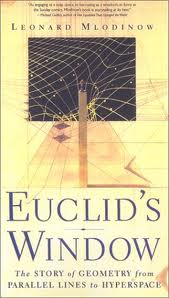
Euclid's Window : The Story of Geometry from Parallel Lines to Hyperspace by Leonard Mlodinow

A good introduction to the history of geometry. Beginning with Pythagoras and Euclid, this book goes on to discuss the great revolutions in geometry, from the co-ordinate system of Descartes, to the non-Euclidean spaces of Gauss and Riemann, to the general theory of relativity of Einstein, and finally the mind-bending geometric spaces of string theory. Overall, this is a great beginning for anyone interested in the study of space.

3 out of 5 stars

Everything and More: A Compact History of Infinity (Great Discoveries) by David Foster Wallace

I had no idea that the late-David Foster Wallace was a math aficionado. I was therefore pleasantly surprised to stumble across this captivating book on the history of infinity. Though certain parts of the book went over my head -- you really need a strong background in calculus and set theory to full appreciate this work -- I was still drawn in by many of the fascinating mathematical concepts related to infinity. From Zeno's paradox to the creation of infinitesimals to the work of Georg Cantor, this book inspired me to read further on number theory and the concept of infinity.

3 1/2 out of 5 stars

Wednesday, December 22, 2010

The Nothing that Is: A Natural History of Zero by Robert Kaplan

A fascinating history of the number zero. From its beginnings in Mesopotamia -- where the Sumerians first conceived of this concept -- to its subsequent development by the Greeks, Indians and Arabs, Kaplan outlines the wonderful story of this curious "nothing" that somehow exists. From a symbol signifying the "absence" of a number / something, to its eventual development as an integer in its own right within positional notion, this book explains why the creation of zero was one of the most important developments in mathematics, and the very important role that it plays in such areas as algebra and calculus.

3 out of 5 stars

Tuesday, December 21, 2010

The Age of Abundance: How Prosperity Transformed America's Politics and Culture by Brink Lindsey

This book is an interesting take on the culture wars in the United States. Written from a libertarian perspective, it argues that political debate in the U.S. is dominated by two ideological minorities. On the left, there is a liberal class that promotes the cultural and sociological fruits of capitalism (e.g. cultural experimentation; an increasing capacity to pursue intellectual and scientific pursuits), while criticizing the very economic system that makes these fruits possible. Meanwhile, on the right, there are political partisans who recoil at the cultural opportunities created by capitalism, while defending the economic system that gives rise to these opportunities.

The thesis of the book is that these two extremes are vocal but minority groups. The majority – the libertarian center – comprises people who are more socially permissive than those on the right, but who also believe in free markets and the capitalist structure, which puts them at odds with many on the left.

I found this thoughtful book to be very enjoyable and would recommend it to anyone interested in U.S. politics. If I were to have one critique, however, is that it fails to describe in any great detail the so-called libertarian center. Though we hear a lot about hippies on the left and the religious-right, there is relatively little discussion of the center. The resulting effect is akin to a good comedian who forgets to say the punchline.

3 1/2 out of 5 stars

Sunday, December 19, 2010

Universe on a T-Shirt: The Quest for the Theory of Everything by Dan Falk

A fascinating history of the scientific search for the Theory of Everything, i.e. a unifying theory that explains the structure of the universe. Ranging from the ancient Greek philosopher Democritus, who speculated that matter was formed by a basic entity called atomon – today we call them atoms – to the Copernican revolution in the middle ages, the development of Newtonian mechanics in the 17th and 18th centuries, the formation of electromagnetic theory in the 19th century, Einstein’s discovery of special and general relativity in the first-half of the 20th century, and the mind-blowing conclusions of quantum mechanics and string theory, this book is a captivating read.

After describing how scientists have searched for answers to such questions as “what is the universe? What is it made of? How did it begin? And how will it evolve?” Dan Falk concludes his book by discussing the limits of scientific knowledge, and what a Theory of Everything, if one is ever found, would mean. A great read for anyone interested in the history of physics and the latest theories of the structure of the universe.

3 1/2 out of 5 stars